
Forex Trading for Beginners
RoxanaRoxana’s Journal
The first puzzling thing about a forex trade might be the small minus sign that appears the moment you open it. How can you be down when the price has barely moved? We’ll follow one example from the price on the screen to the cents on the statement, with practice money the whole way.

Forex means foreign exchange, or exchanging one currency for another.
In forex trading, what you gain or lose depends on how the exchange rate moves.
You can see how that works on paper or in a practice account, without a deposit.
What you trade when you trade forex
Say you’re booking a $110 room and you have euros. At $1.10 for one euro, the room costs €100 before fees.
At $1.00 for one euro, it costs €110. The hotel charged the same dollars.
The exchange rate changed what the room cost you.
That’s the everyday version of forex. Travellers exchange money to spend it.
Businesses exchange it to pay bills in other currencies or to protect themselves against a change in rates.
Traders take a position to try to profit from a change.
News about inflation, jobs and interest rates can move those prices when it changes what people expect.
A headline alone won’t tell you which way the rate will go.
In a spot exchange, you agree on a rate and the two currencies change hands soon after.
Some apps instead offer a contract based on the exchange rate.
A CFD, short for contract for difference, is one example.
If it tracks EUR/USD, you settle the gain or loss in money when you close the trade.
You won’t have euros to spend. Check the account agreement to see what the app offers.
Many forex products trade around the clock on weekdays.
If the price on your screen stops updating, check the provider’s hours for breaks or holidays.
Read a currency pair and count the move
EUR/USD at 1.1000 means one euro is worth 1.1000 U.S. dollars.
The first currency, EUR, is the base currency. Think “one of these.” The second, USD, is the quote currency.
It tells you the price of that one euro.
A buy position, also called going long, can make money when EUR/USD rises.
A sell position, or going short, can make money when it falls.
In both cases the prices you actually get and the fees you pay decide your result.
When the pair rises, one euro buys more dollars. This tells you how the two currencies moved against each other.
It says little about what either did against the yen or pound.
A pip is a small standard step in the exchange rate.
In most currency pairs, it’s 0.0001. A move in EUR/USD from 1.1000 to 1.1005 is 5 pips.
In yen pairs, it’s usually 0.01. USD/JPY from 150.00 to 150.05 also moved 5 pips.
If EUR/USD shows 1.10005, the last digit is a tenth of a pip, often called a pipette.
Turn pips into money
Your position size is how many units of the first currency your trade is based on.
For EUR/USD, those units are euros. A lot is a bundle of those units.
Some apps take an amount in lots and others let you type in the number of units.
Check what one lot means on your screen and the smallest amount it lets you trade.
| Common lot size | Units of EUR in EUR/USD | Value of one pip in USD |
|---|---|---|
| 1.00 lot | €100,000 | $10.00 |
| 0.10 lot | €10,000 | $1.00 |
| 0.01 lot | €1,000 | $0.10 |
On a €1,000 EUR/USD trade, one pip is worth $0.10. Here’s the maths.
A pip is $0.0001 per euro. Multiply by 1,000 euros and you get ten cents.
If your result is in a different currency from your account, it needs to be converted.
A 1,000-unit USD/JPY trade moves ¥10 per pip. At ¥150 per dollar, that’s about $0.067.
Your app might let you enter 1.00 when you meant 0.01.
On the EUR/USD example above, the same 20-pip loss would then be $200 instead of $2, before extra charges.
Read the units before you read the chart.
Why the trade starts below zero
Imagine you’re about to buy EUR/USD in a practice account.
The order screen gives you two prices. The bid is the price you can sell at, 1.1000.
The ask is the price you can buy at, 1.1002. The gap is the spread, two pips in this example.
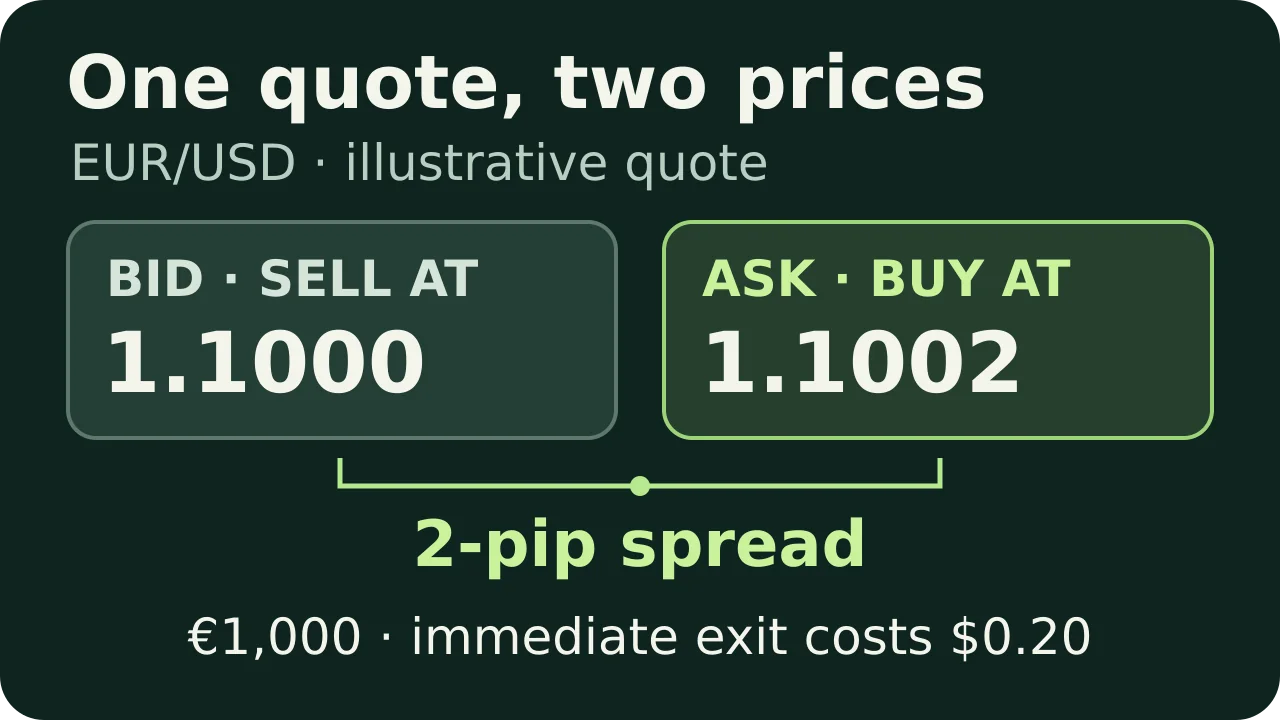
You buy at 1.1002. If you close right away and the prices haven’t changed, you sell at 1.1000.
On a €1,000 position, that gap is two pips at $0.10 each.
You’re down $0.20 before any separate fees. If you opened with a sell instead, you’d sell at the bid and buy back at the ask.
Check the smallest trade you can place and what it costs to open and close it.
A small deposit can still leave you facing a trade bigger than you intended.
When the price rises and you still lose
You bought at 1.1002. Now imagine the sell price goes up one pip from 1.1000.
Are you back to even? Find that row below. Each row shows a different way the same trade could end.
Assume you trade at the prices shown and pay $0.10 to open and $0.10 to close, with no overnight charge or currency conversion.
| What happens | Bid when you close | After the price move and spread | After both fees |
|---|---|---|---|
| Bid stays where it was | 1.1000 | −$0.20 | −$0.40 |
| Bid goes up 1 pip | 1.1001 | −$0.10 | −$0.30 |
| Bid goes up 2 pips | 1.1002 | $0.00 | −$0.20 |
| Bid goes up 5 pips | 1.1005 | +$0.30 | +$0.10 |
One pip up still leaves you down $0.30 after both fees.
Even when the sell price rises five pips, you keep just $0.10.
You paid two pips more than the starting sell price, so you’ve gained three pips before commission.
When you work from the prices you actually traded at, the spread is already in the result.
A flat line on the chart can hide a bigger loss. Suppose the line shows the midpoint, halfway between the buy and sell prices.
The spread widens from 1.1000 / 1.1002 to 1.0999 / 1.1003.
The chart stays at 1.1001, but your sell price drops one pip.
Close there and you lose another $0.10 on the same trade, before any separate fees.
One practice trade
Choose the exit bid for this simulated buy of €1,000. Each pip is worth $0.10. The opening and closing commissions are $0.10 each.
After both fees
The table above shows all four results. Enable JavaScript to switch between scenarios here.
What else can change the amount you keep
Commission is a separate trading fee. Does the amount you see cover opening the trade, closing it, or both?
The spread still counts on a zero-commission account.
Even a spread advertised as “from zero” can be wider when you trade.
Keep a trade open past the provider’s daily cutoff and a charge or credit may show up in your account.
That’s overnight financing, sometimes called a swap or rollover.
Check the cutoff time and the rate for the currency pair you’re trading.
Buying and selling the same pair can have different rates.
If the provider converts your result into your account currency, check what that conversion costs.
A stop-loss is an order that aims to get you out when the price hits a level you set.
Suppose you set that level at 1.0982 on your buy trade.
If the price drops fast, you might get 1.0977 when the trade closes.
That’s another 5 pips against you, or $0.50 on €1,000 before fees.
A difference between the price you expected and the one you got is called slippage. It can work for or against you.
What leverage changes
Leverage lets you open a trade worth more than the money you put up.
The amount the provider sets aside in your account to open the trade is called margin.
At 20:1 leverage, you need $1 in margin for every $20 the trade is worth.
In our example, €1,000 at 1.1002 is worth $1,100.20.
Divide that by 20 and you get $55.01 in opening margin.
Ask yourself two different questions. How much do I need to open this trade?
That’s the margin. How many dollars do I lose if the trade closes 20 pips below my buy price?
That depends on how many units you trade.
| Example with a USD account | €1,000 at 10:1 | €1,000 at 20:1 | €10,000 at 20:1 |
|---|---|---|---|
| Position value at 1.1002 | $1,100.20 | $1,100.20 | $11,002.00 |
| Opening margin | $110.02 | $55.01 | $550.10 |
| Loss at a 1.0982 exit bid | $2.00 | $2.00 | $20.00 |
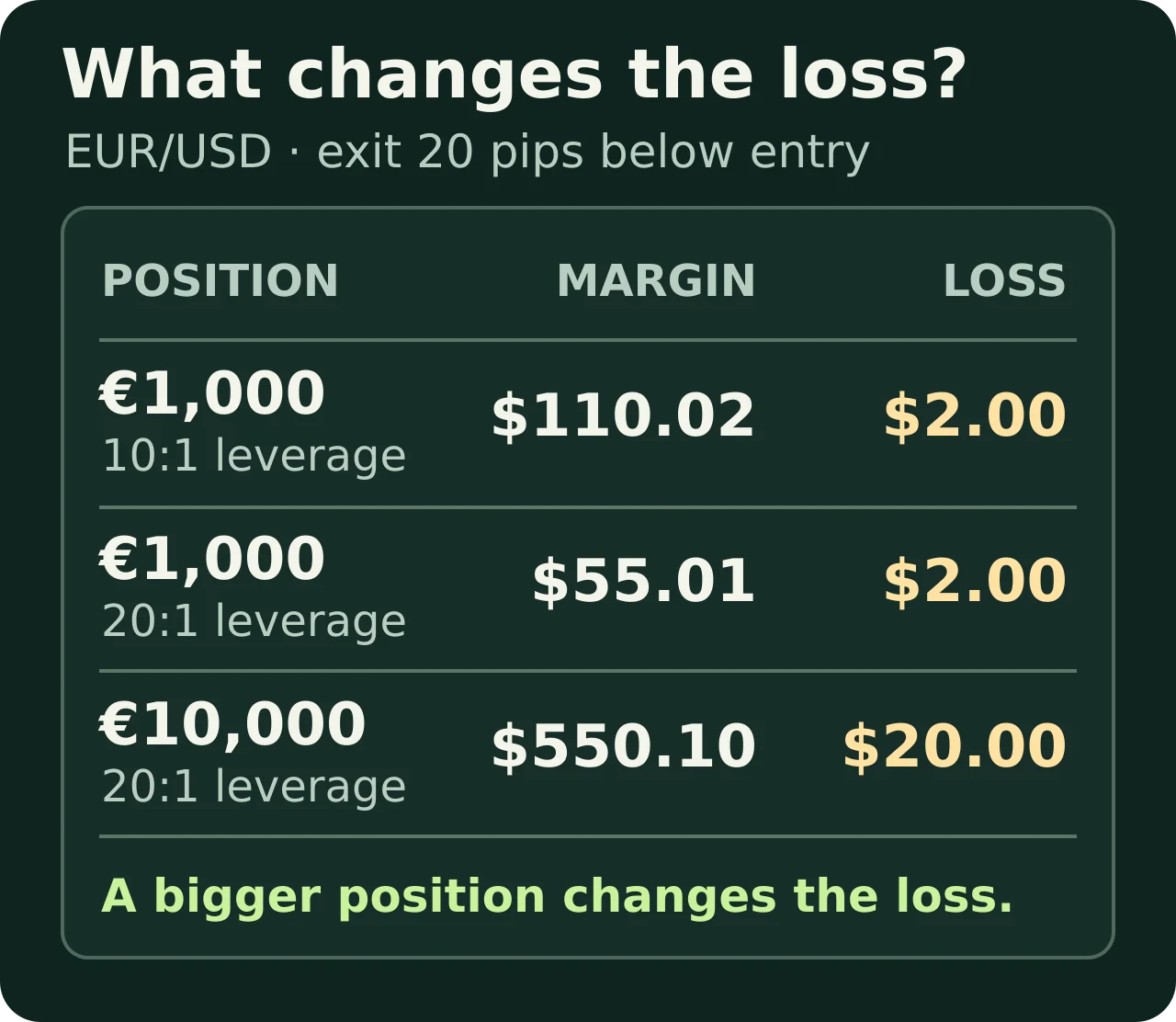
Look at the two €1,000 trades. The margin falls from $110.02 to $55.01, but a 20-pip drop from your entry still costs $2 before fees.
On the €10,000 trade, the same move costs $20. Leverage lets you take a bigger trade, and that can mean a much bigger loss.
Losses can exceed the margin set aside for the trade.
If the money left in your account, after counting any gains or losses on open trades, falls too low to support your positions, the provider may close one or more of them.
That’s called margin close-out. The trigger and protections depend on your account, product and local rules.
A first demo session without a deposit
A demo account is a simulator that uses practice money.
A broker demo can teach you its order screen. A standalone simulator, often called paper trading, lets you practise without needing a live brokerage account.
You can do the same exercise on paper using this article’s prices.
- Find both prices. Pick EUR/USD and confirm the screen says demo. Write down the bid, ask and difference in pips. If there’s only one price on the chart, open the order screen and look for both.
- Write down your best guess before you click. Use 1,000 units if your demo allows it. How much is one pip worth? What would it cost to close right away if the prices stayed the same? Include any commission the demo shows.
- Open and close one practice trade. Write down the two prices you actually got. Find the closed trade in the account history and work out the result yourself. If a number is off, look for a moving quote, the wrong trade size or a charge.
- Find out what the simulator leaves out. Can you see how a stop behaves? Does the history show overnight charges? Could the demo fill your order at a different price than you asked for? Check its help page. A simulator can handle costs, order prices and forced closures differently from a real account.
A reader on the BabyPips forum asked whether to start with a demo or a small real-money account.
They later said they’d try a demo, eager to do something after reading and watching.
If you’re ready to try it too, you can start with the prices in this article. Read the forum discussion.
At the end, try explaining the result in one sentence.
If it surprised you, say what you missed. A few wins with practice money tell you little about how a real trade will go.
You can keep practising for as long as you like.
What to check if you ever consider a real account
Start with the legal name of the company in the account agreement.
A brand can use different companies for different countries.
Use your regulator’s official register to check the company, the permission for the product and its contact details.
In the UK, the FCA explains how to check a firm. In the U.S., the CFTC links to the NFA’s BASIC database.
A copied registration number can belong to a genuine company with a different website.
FCA firm checks · CFTC registration checks.
Then ask what happens if a trade goes against you. When can the firm close your trades?
Does your account have negative balance protection, which can limit what you owe if losses take the account below zero?
Find out how withdrawals work before sending money or sharing personal information.
Treat guarantees of returns, pressure to deposit and demands for an unexpected payment to release your money as warning signs.
If you’re learning because you need to pay a bill or replace income soon, leveraged trading can make that problem worse.
You can stay with the simulator, or stop here.