
Broker research
Compare brokers by the account you can actually open
Two accounts under the same broker name can come with different legal entities, products and costs. Find out which terms would apply to you before comparing the headline numbers.

Start with the entity, product and account
A single brand can serve different countries through different firms. Get the documents for the account you would open before weighing features or prices.
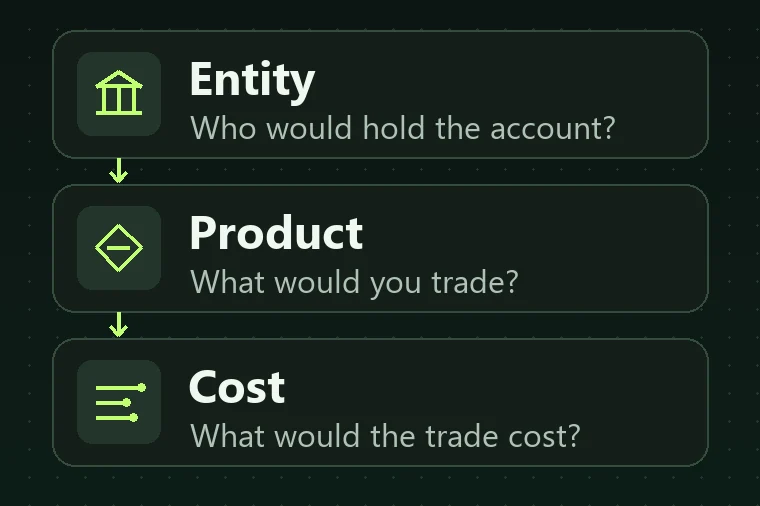
Find the firm that would hold your account
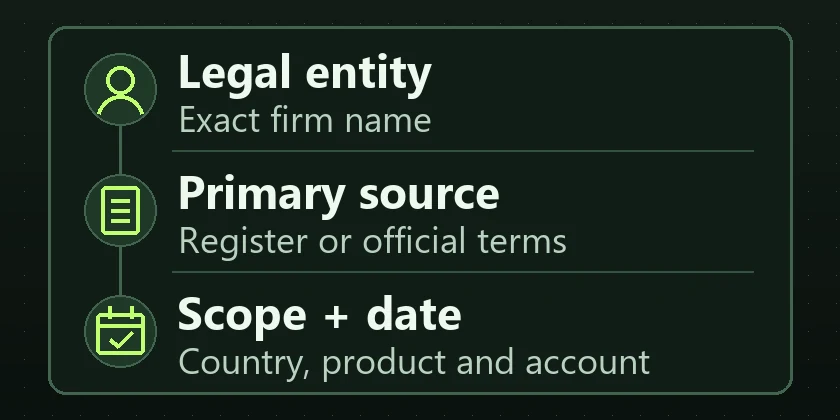
Start with your country of residence and the legal name on the application or client agreement. Search the relevant regulator’s register for that exact firm and the permission for the service you intend to use. The FCA Firm Checker is an example for UK checks. Match the regulator’s contact details with the firm’s website, especially if the names look familiar.
Record the legal name, register entry, jurisdiction, client category and the date checked.
Confirm what you would actually trade
Read the instrument specification and product document. For example, a share CFD gives you exposure to a price movement without owning the share. A stock purchase or ETF unit follows different terms, and a spot crypto account has its own custody and withdrawal rules. A platform symbol alone can leave these distinctions unclear.
Write down the instrument, contract type, settlement or ownership and any product-specific restrictions.
Check the account and funding terms
Compare the same account type and the same platform requirements. Check minimum trade size, base currencies, deposit and withdrawal methods, point of conversion and rules for the account you can apply for. If you depend on a particular order type or platform, ask whether your entity and account support it.
Save the account and fee schedules that apply to your country and product. Ask for written confirmation when a material term is unclear.
Risk check: CFDs are leveraged derivatives. Losses can build quickly as the market moves. The protections that apply depend on the firm, product, jurisdiction and client category.
A tight spread can still mean an expensive trade
Pick one trade you can describe precisely. For example, compare the same EUR/USD CFD position, position size, account currency and holding period across two eligible accounts. Use the published schedules, and date any live quote you use.
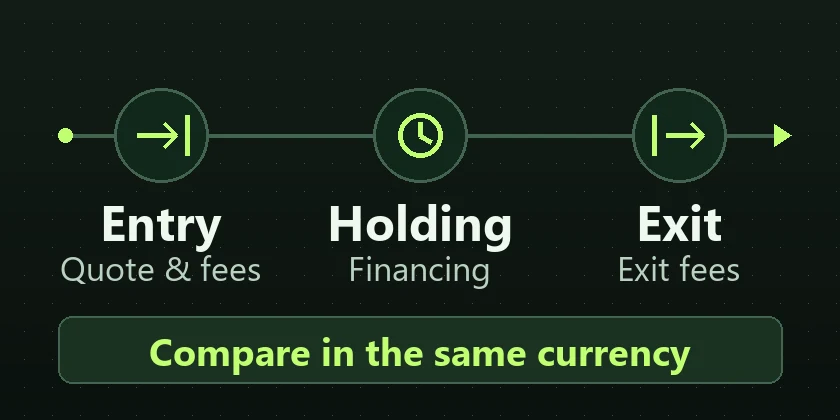
- Spread
Estimate the effect of the bid–ask difference for the same position size.
Record the quote, time and session. Compare observations made in similar market conditions.
- Commission
Identify the charge on entry and on exit, including any minimum.
Check whether the schedule quotes each side separately or the full round trip.
- Overnight financing
Check the rate, debit or credit and the number of rollover days for the intended holding period.
Base the estimate on the actual contract schedule and check holiday or multi-day rollovers.
- Currency conversion
Find out which costs or cash flows convert into your account currency.
Use the same reporting currency for both comparisons. Record the conversion rate or fee separately.
- Funding and other charges
Check deposits, withdrawals and any recurring account charges.
Record when a charge applies. Keep a withdrawal or inactivity fee separate from the cost of opening a trade.
A useful test: Suppose the spread costs $4 on one account and $7 on another for the same position. The first charges $2 on entry and another $2 on exit. The second charges no commission. The round trip costs $8 on the lower-spread account and $7 on the other, before financing or conversion. Repeat the comparison for an overnight hold. Record margin separately as the capital required to open the trade.
A review, a comparison and a fit check answer different questions
Use the format that answers the decision in front of you. Keep the same standard of proof whichever route you take.
Read a review
Understand one provider. Look for the specific entity, account types, products and official terms covered by the review, along with the date they were checked.
Compare two accounts
Hold country, product and trade scenario constant. If one account fails a required product or platform check, a pricing comparison is less useful. See our MT5 guide for a worked platform example.
Check your fit
Use the finder when residence, experience, markets and priorities shape the decision. Take any verified result back to the current account documents before acting.
What counts as evidence?
A claim is useful when you can trace it to the right firm, product and account. Save the document, link, scope and date. If a fee or availability condition is unclear, leave that part of the comparison open and verify it directly.
Broker Fit Engine
Check the profile you would actually trade with
Start with where you live and what you want to trade. The finder can return No verified matches yet. If it does, keep the entity, product and cost checks above as your next step. An empty result tells you we do not have a verified match for those inputs.
GT10x / VERIFIED RESEARCH
Broker Fit Engine
Find a research starting point for your residence, budget and markets. Only verified routes can appear.
Informational research, not personal financial advice. No broker is shown without a verified route.
Affiliate disclosureFrequently asked questions
Why can one broker brand have different terms in two countries?
The firm named in the client agreement can differ by country. Check the legal entity that would hold your account, the relevant permissions for the product, and the terms that apply to you.
Is the minimum deposit a useful way to choose a broker?
It tells you how much you need to fund the account. Check whether that amount varies by payment method. Then check the minimum trade size, which tells you the smallest order you can place, and calculate the exposure it creates. Review withdrawal restrictions, available products and trade charges before comparing accounts.
Does a low spread mean lower total costs?
Spread is one input. Check commission, financing and conversion for the same position size, account currency and holding period. Use quotes from similar conditions and note the time.
What does “No verified matches yet” mean?
GT10x could not return a verified match for the submitted profile. It does not establish that every broker is unavailable. Continue with the official documents and country, product and cost checks.
Research and disclosure
GlobeTrade10x publishes independent research for traders. Use this page to organise your checks and confirm current terms with the relevant firm and regulator. Learn how we make money.